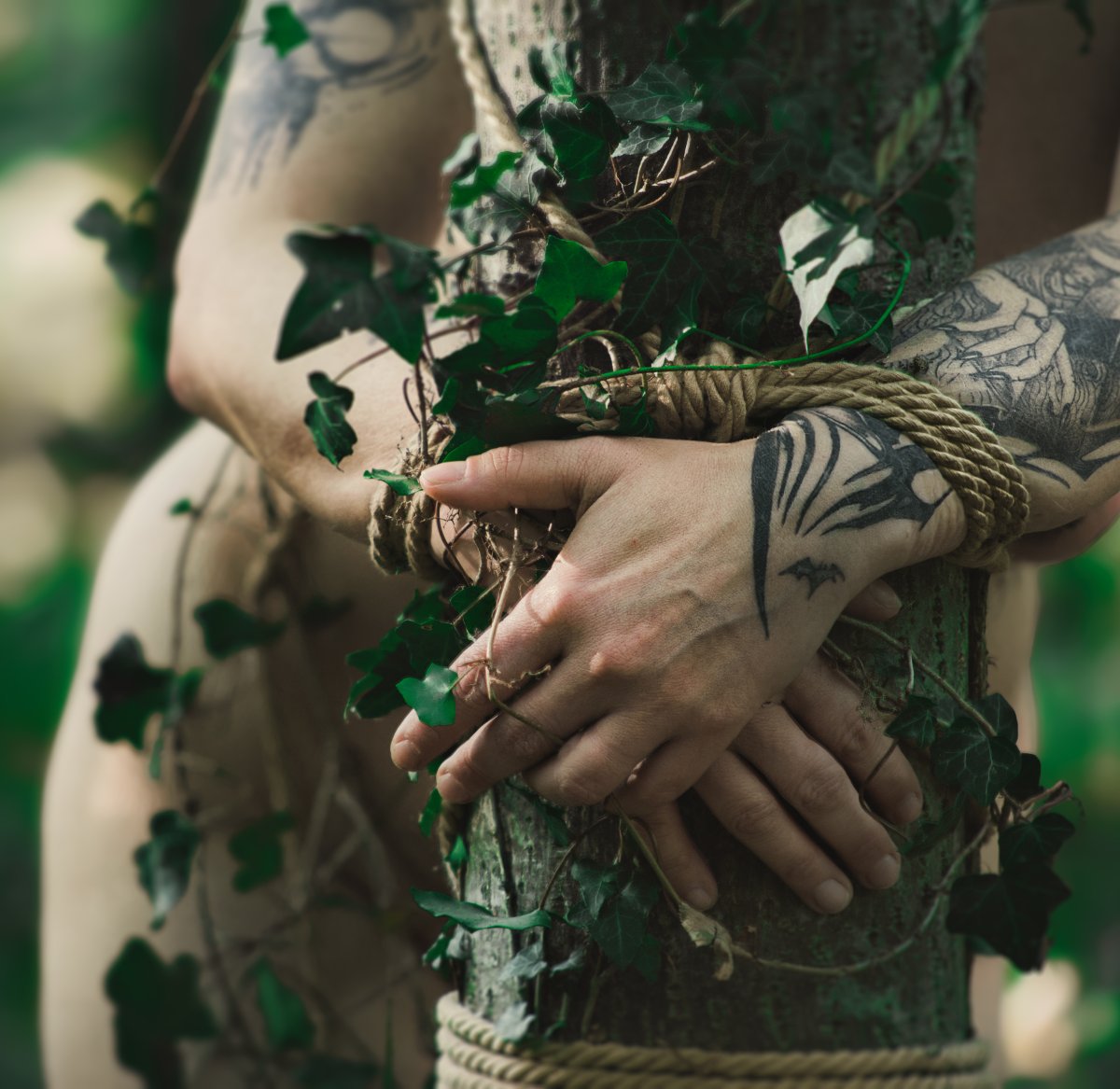


On the way to the shoot, I already knew that I wanted the frames to be tight. I wanted to focus on details found within nature rather than showing the entire figure or the surrounding landscape. In my imagination, however, there were small wildflowers stealing part of the attention, with the hands acting almost like a living vase.
During the entire drive I kept watching the flowers growing along the roadside, silently judging which ones might work best in the photographs. Once we reached the forest, reality quickly dismantled that plan. Although the forest feels almost like a second home to me, this time it managed to surprise me. There were no flowers. There was hardly even any of the moss I had expected to find.
We hung up the hammock, established our little base and I went looking for a tree. I wanted one that was not too thick, relatively straight and preferably covered with something that could become part of the composition itself. The only thing the forest seemed to have in abundance was ivy.
So I chose a tree heavily covered with it, even though at first I had the feeling that finding something visually interesting in the immediate area would not be easy. We began with the first frames. They were correct. For a moment I even thought the shoot would go quickly and that we would have time to create many more images.
Then I looked at the photographs on the camera screen and realised that something was missing. The tree and the human figure still felt like two separate elements.
I began weaving the ivy between the hands and fingers. Suddenly there was a connection. The plant was no longer merely part of the background; it seemed to travel from the tree onto the body. When the result was already close to what I wanted, I noticed one more possibility: if the ivy was wrapping itself around the trunk and the hands, the ropes should behave in a similar way.
That was the moment when the composition began to make sense. Ivy and rope created related lines, crossing and wrapping around different forms while guiding the eye through the photograph. What had initially been nothing more than a substitute for the missing flowers became the actual subject of the image.
The next photograph was intended to exist somewhere on the border of implied and concealed nudity. I did not want to build it purely on suggestion or hide everything behind an extremely shallow depth of field. Instead, we searched for a calm, harmonious position in which the body would not compete with the tree but become part of the same structure.
In the end, it was precisely the absence of what I had originally planned that defined the series. Flowers were replaced by ivy. Decoration was replaced by the recurring rhythm of vines and rope. And the hands that were originally supposed to serve merely as a “vase” became the point where the human body and nature begin to intertwine.

Assistant